




















Search
Space

Historically, astronomers have often named things creatively, bizarrely, and often inaccurately. But which terms are the most egregious?

Seeking life beyond the Solar System, we first look to the closest star systems with Earth-like planets. Here's why that's not good enough.

If humanity lives in an otherwise barren Universe, we'll have to forge philosophy that fills the void.

First discovered in the mid-1960s, no cosmic signal has taught us more about the Universe, or spurred more controversy, than the CMB.

From LIGO, there weren't enough neutron star-neutron star mergers to account for our heavy elements. With a JWST surprise, maybe they can.

It's the ultimate game of cosmic "cover up," as the dimming occurs when a circumbinary disk from a nearby star passes in front of T Tauri North.

Life might be more common across the Universe than the "Hard Steps Model" suggests.

Here in our Universe, stars shine brightly, providing light and heat to planets, moons, and more. But some objects get even hotter, by far.

Most stars shine with properties, like brightness, that barely change at all with time. The ones that do vary help us unlock the Universe.

Many of us look at black holes as cosmic vacuum cleaners: sucking in everything in their vicinity. But it turns out they don't suck at all.

There's no upper limit to how massive galaxies or black holes can be, but the most massive known star is only ~260 solar masses. Here's why.

Featuring SpaceX's "Mechazilla," a first-of-its-kind spacewalk, and more.

A recent measurement has simultaneously settled an ongoing scientific debate while puzzling scientists.

Electromagnetism, both nuclear forces, and even the Higgs force are mediated by known bosons. What about gravity? Does it require gravitons?

There was a lot of hype and a lot of nonsense, but also some profoundly major advances. Here are the biggest ones you may have missed.

Even with just a momentary view of our galaxy right now, the data we collect enables us to reconstruct so much of our past history.

The closest known star that will soon undergo a core-collapse supernova is Betelgeuse, just 640 light-years away. Here's what we'll observe.
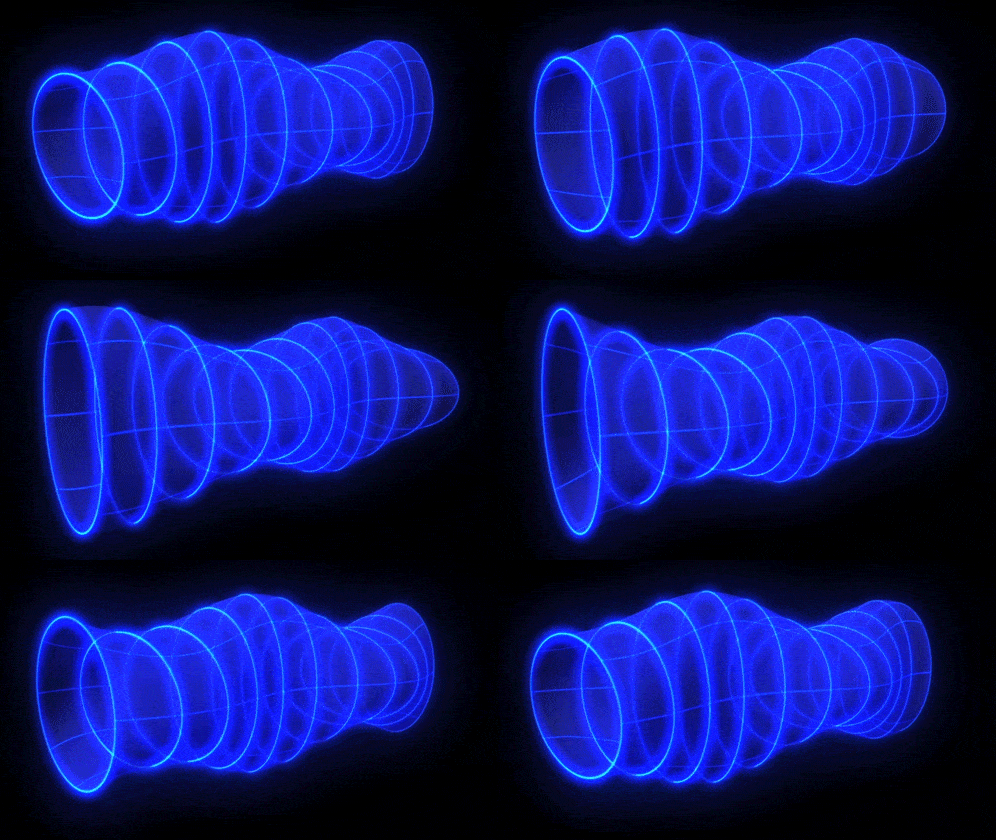
Gravitational waves are the last signatures that are emitted by merging black holes. What happens when these two phenomena meet in space?

In November 1974, astronomers used the radio telescope at Puerto Rico’s Arecibo Observatory to send a hello to the universe.

Scalars, vectors, and tensors come up all the time in physics. They're more than mathematical structures. They help describe the Universe.

Welcome to The Nightcrawler — a weekly newsletter from Eric Markowitz covering tech, innovation, and long-term thinking.

Recent controversies bode ill for the effort to detect life on other planets by analyzing the gases in their atmospheres.
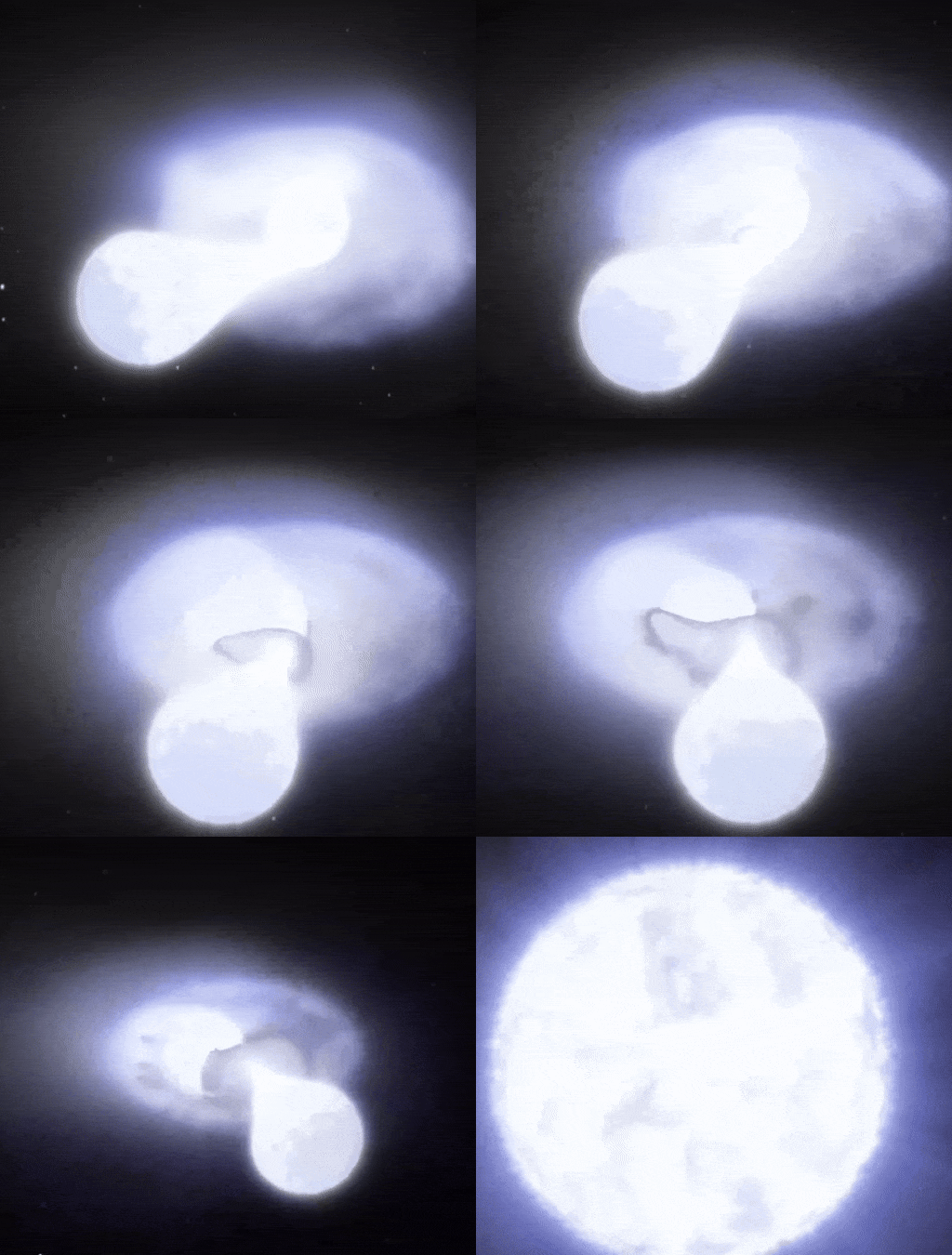
Since 1930, type Ia supernovae have been thought to arise from white dwarfs exceeding the Chandrasekhar mass limit. Here's why that's wrong.

In astronomy, a star's initial mass determines its ultimate outcome in life. Unless, that is, a stellar companion alters the deal.

Humans, when we consider space travel, recognize the need for gravity. Without our planet, is artificial or antigravity even possible?

All the stars, stellar corpses, planets, and other large, massive objects take on spherical or spheroidal shapes. Why is that universal?

The 5th brightest star in our night sky is young, blue, and apparently devoid of massive planets. New JWST observations deepen the mystery.

Many mavericks look to Einstein as a unique figure, whose lone genius revolutionized the Universe. The big problem? It isn't true.

More than two years after JWST began science operations, our Universe now looks very different. Here are its biggest science contributions.

The fabric of spacetime is four-dimensional, with three for space and only one for time. But wow, time sure is different from space!