




















Search
Space

Because of dark energy, distant objects speed away from us faster and faster as time goes on. How long before every galaxy is out of reach?

To Fred Hoyle, the Big Bang was nothing more than a creationist myth. 75 years later, it's cemented as the beginning of our Universe.

JWST has puzzled astronomers by revealing large, bright, massive early galaxies. But the littlest ones pack the greatest cosmic punch.

Tech designed to fuse atoms might be able to clean up space, too.

Leap day only comes once every four years, including in 2024. But the reason we have it, including when we do and don't, may surprise you.

Meanwhile meteorite hunters rushed to Berlin to find this most rare space rock.

NASA gave three robots plans for a moon shelter, and the robots figured out how to build it.

Until the Apollo missions, we had no idea how the moon got here, just a series of educated guesses. They rewrote the story of the moon’s origins.

So far, gravitational waves have revealed stellar mass black holes and neutron stars, plus a cosmic background. So much more is coming.

Almost every large structure in the Universe displays a 5:1 dark matter-to-normal matter ratio. Here's how some galaxies defy that rule.

Although many of Einstein's papers revolutionized physics, there's one Einsteinian advance, generally, that towers over all the rest.

Beyond the planets, stars, and Milky Way lie ultra-distant objects: galaxies and quasars. Here's how far back we've seen throughout history.

Although early Earth was a molten hellscape, once it cooled, life arose almost immediately. That original chain of life remains unbroken.

The Earth that exists today wasn't formed simultaneously with the Sun and the other planets. In some ways, we're quite a latecomer.

As planets with too many volatiles and too little mass orbit their parent stars, their atmospheres photoevaporate, spelling doom for some.

The DUNE project will beam tiny neutrinos across vast distances. But the first step involved moving a heavier material: 1 million tons of rock.

Early on, only matter and radiation were important for the expanding Universe. After a few billion years, dark energy changed everything.

Stars are born, live, and die within the spiral arms of galaxies like the Milky Way. These 19 JWST spirals deliver unprecedented riches.

If our Milky Way were located in the Virgo cluster instead of the Local Group, chances are we'd already be a "red and dead" galaxy.

Here in our Solar System, we only have one star: a singlet. For many systems, including the highest-mass ones, that's anything but the norm.

The answer is set to change in the year 2113, a recent estimate suggests.

Observations of an enormous cosmic structure, dubbed the "Big Ring," seem to violate the Copernican principle.

Our cosmic home, planet Earth, has been through a lot over the past 4.5 billion years. Here are some of its most spectacular changes

For every proton, there were over a billion others that annihilated away with an antimatter counterpart. So where did all that energy go?

One newly discovered, ancient star has a composition unlike any other. Explaining its existence is already blowing astronomers' minds.

Here's why the answer may forever elude scientists.

As early as we've been able to identify them, the youngest galaxies seem to have large supermassive black holes. Here's how they were made.
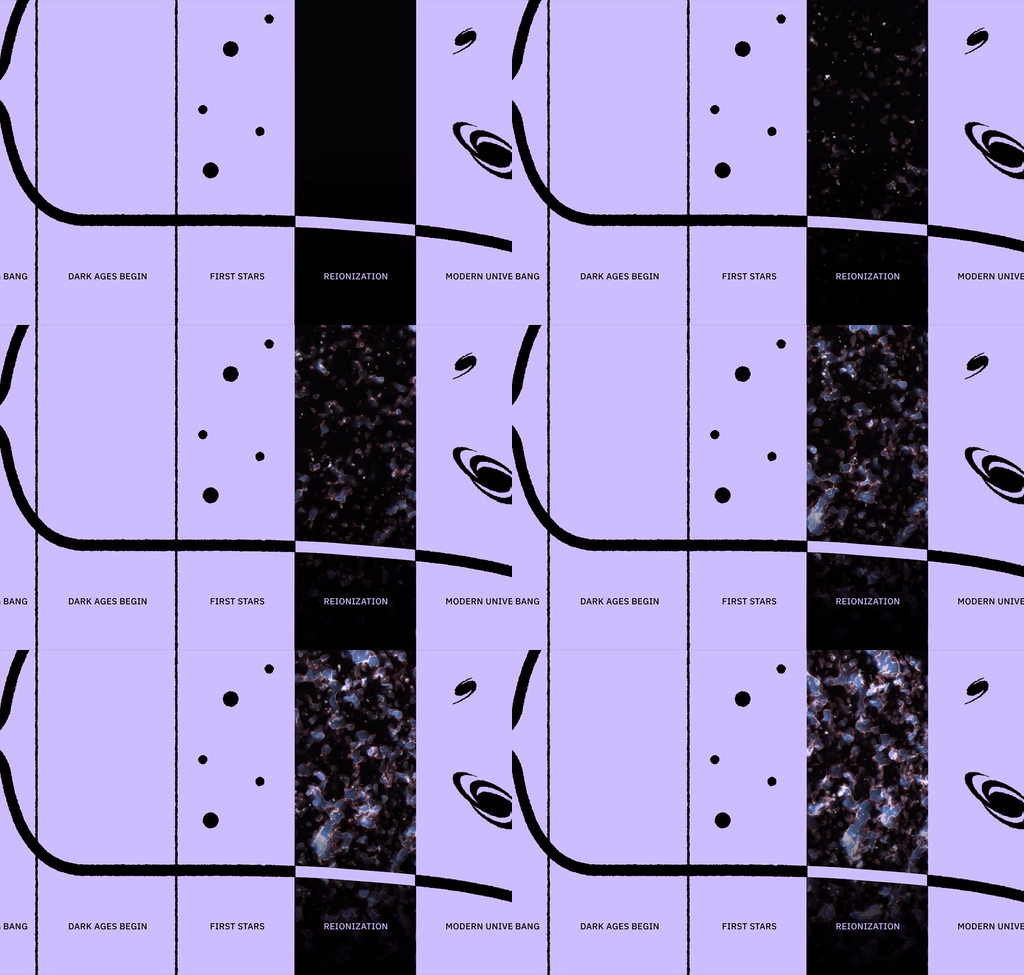
For 550 million years, neutral atoms blocked the light made in stars from traveling freely through the Universe. Here's how it then changed.

The first tests of optical communications far from Earth will take place aboard the asteroid-bound Psyche spacecraft

The Universe is an amazing place. Under the incredible, infrared gaze of JWST, it's coming into focus better than ever before.