




















Search
Universe Expansion

"Color" with respect to the strong force is just an analogy. Here's how to understand it without colors, group theory, or any advanced math.

The distance ladder and the CMB give incompatible values for the expansion rate. A new study shows just how robust the Hubble tension is.

Known as the "past hypothesis" problem, the Universe's initially low entropy has long puzzled scientists. Now, cosmic inflation solves it.

As the world teeters on the brink of nuclear war, distant, advanced civilizations would never know it. Earth appears peaceful from far away.
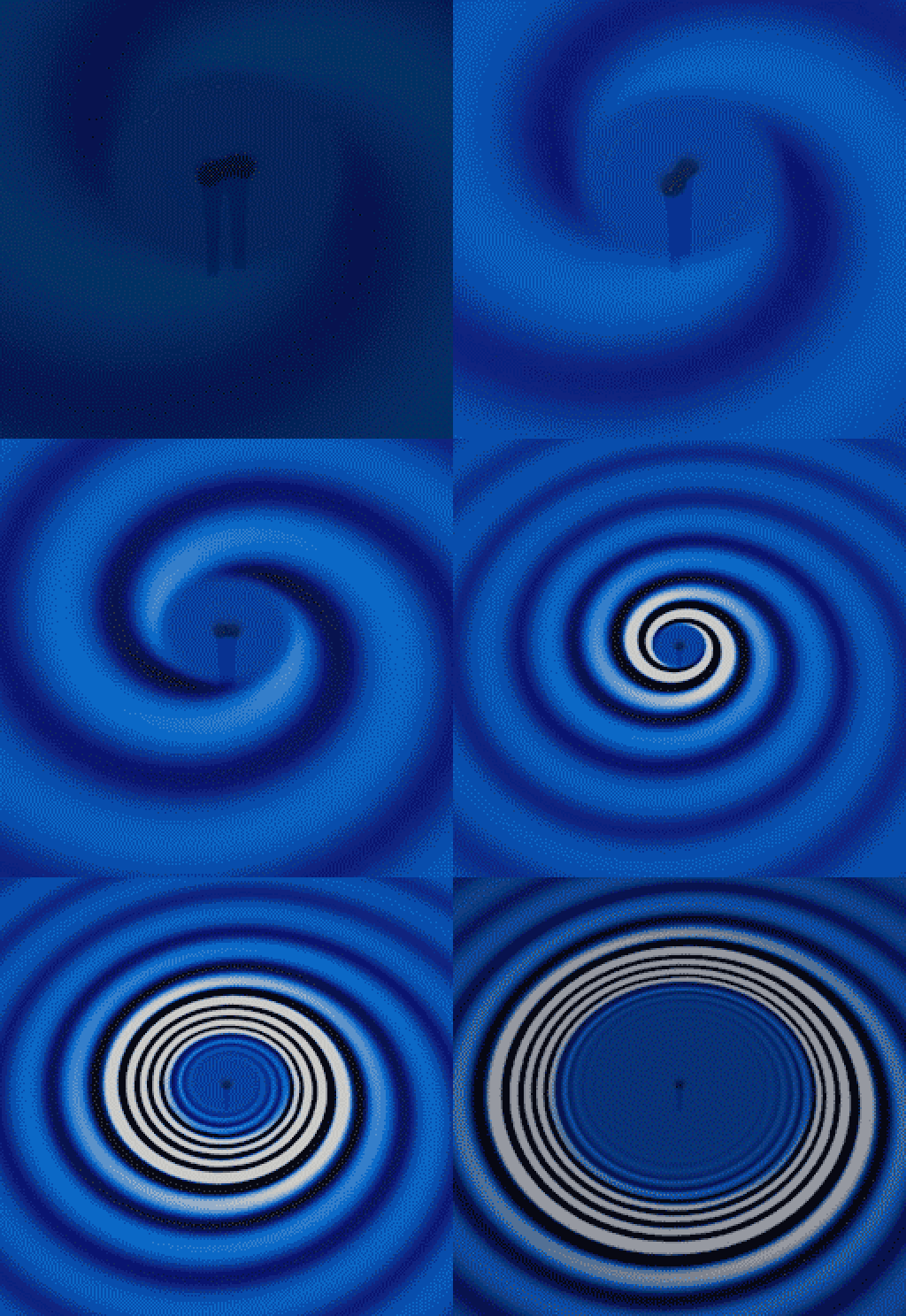
As light travels across the Universe, it's subject to cosmic expansion, changing fields, and relative motion. How about gravitational waves?

Is dark energy evolving with at least 99.99% confidence? Despite the quality of recent data, scientists have every reason to be skeptical.

In a 13.8 billion year old Universe, a few seconds hardly seems like it matters. But these minuscule changes sure do add up over time.

Most massive galaxies are spiral or elliptical shaped. But peculiar galaxies showcase the beautiful violence that helps explain our cosmos.

Early on, the Universe needed near-perfect flatness, or atoms, stars, and galaxies couldn't form. What happens once dark energy takes over?
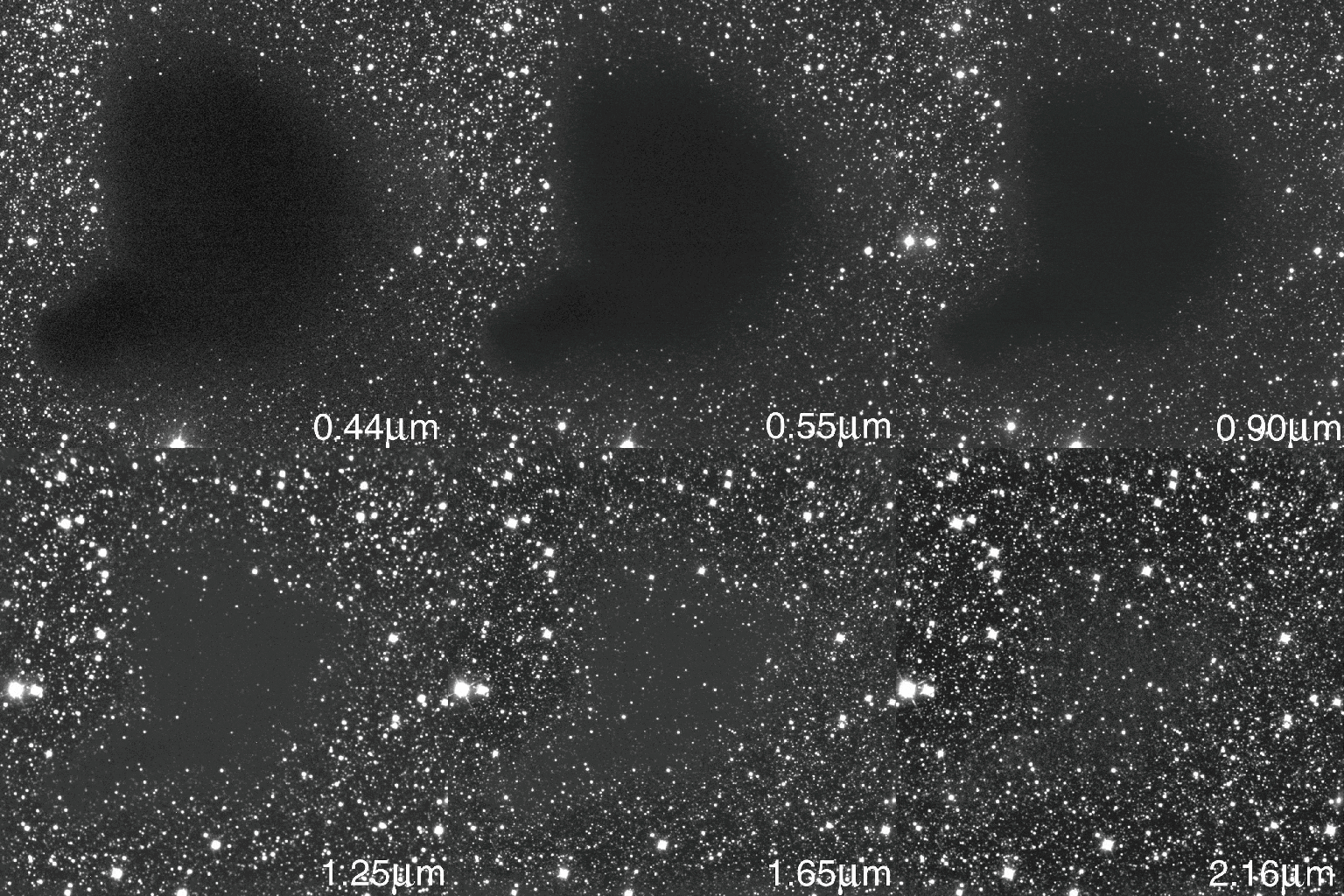
The image you're seeing isn't a hole in the Universe, and the cosmic voids that do exist aren't hole-like at all.

Looking up at the night sky gives us a glimpse of the Universe beyond our terrestrial concerns. Here's the science of what's out there.

No matter what physical system we consider, nature always obeys the same fundamental laws. Must it be this way, and if so, why?

In theory, the fabric of space could have been curved in any way imaginable. So why is the Universe flat when we measure it?

Binary black holes eventually inspiral and merge. That's why the OJ 287 system is destined for the most energetic event in history.

Over billions of years, fewer stars form, galaxies mutually recede, and the Universe becomes ever darker. Here's how fast it all happens.

Not everyone accepts the scientific consensus; some even make careers out of challenging it. But only a select few do it the right way.

Resembling a cosmic brain, the Exposed Cranium Nebula instead shows a dying, massive star, as JWST reveals. Its fate remains uncertain.

In traveling through the expanding Universe, particles slow down while light and gravitational waves redshift. What degrades and what won't?

Smashing things together at unprecedented energies sounds dangerous. But it's nothing the Universe hasn't already seen, and survived.

No civilization, no matter how successful, can last forever. What does the non-detection of intelligent aliens mean for our own longevity?

The discovery of CDG-2, a galaxy that's more than 99.9% dark matter, could reveal a new population of ultra-faint galaxies. But is it real?

Forget about the terawatt lasers we're making on Earth. The Universe makes natural ones thousands of times more powerful than the Sun.

The fundamental building blocks of reality are indivisible: quanta that cannot be split or divided. Our understanding remains incomplete.

Long after the last star burns out, the Universe will experience its end state: a heat death. Will everything prior then be meaningless?

The Universe is expanding, the expansion is accelerating, and some galaxies even recede faster-than-light. Can we see a change in real time?

Before Sun-like stars die, they transition from AGB red giants into preplanetary nebulae. Here's how Hubble sees the famous Egg Nebula.

Here in our modern Universe, it's cosmic dust that forms planets, complex molecules, and enables life. But how did the Universe create it?

13.8 billion years have passed since the Big Bang, but many stars will survive for longer than that. What's the longest-lived a star can be?

Many collaborations have used JWST to take deep-field images: some wider and some deeper than others. Here's how it can surpass them all.

The Universe formed stars, galaxies, and even galaxy clusters extremely early on in our cosmos. This new marvel is one more JWST surprise.