




















Search
Universe Expansion

Every time our Universe cools below a critical threshold, we fall out of equilibrium. That's the best thing that ever happened to us.

The strongest tests of curved space are only possible around the lowest-mass black holes of all. Their small event horizons are the key.

The Universe is 13.8 billion years old, going back to the hot Big Bang. But was that truly the beginning, and is that truly its age?

There's the textbook answer, then there's the real answer.

At 1,600 light years away, the black hole is practically in our cosmic backyard.

It's rare that one single image packs so much beauty and science simultaneously. This Hubble view of a nearby star-forming region has both.

Supermassive black holes at the centers of galaxies gobble up whatever matter ventures too close, becoming active. Here's how they work.

We're used to scientists telling us about the math and physics behind astronomical events. But what does studying space make us feel?

You are trapped in time. You never live in the world as it is but only as you experience it as it was.

Science is for everyone, even those possessing strongly held beliefs that seem to conflict with the best available evidence.

IceCube just found an active galaxy in the nearby Universe, 47 million light-years away, through its neutrino emissions: a cosmic first.

We know the Universe is expanding, but scientists don't agree on the rate. This is a legitimate problem.

In 1974, Stephen Hawking showed that even black holes don't live forever, but emit radiation and eventually evaporate. Here's how.

In 1995, Hubble peered at the Pillars of Creation, forever changing our view. Now in 2022, JWST completes the star-forming puzzle.

The stars circle each other every 51 minutes, confirming a decades-old prediction.

Most exoplanets have been found around single stars via the transit method. But binary star systems might contain even more of them.

Early relics and late-time objects give incompatible results for the expanding Universe. This independent anomaly intensifies the problem.

Practically all of the matter we see and interact with is made of atoms, which are mostly empty space. Then why is reality so... solid?

Are you unhappy with how various events in your life turned out? Perhaps, in a parallel Universe, things worked out very differently.

The Universe gravitates so that normal matter and General Relativity alone can't explain it. Here's why dark matter beats modified gravity.

1.9 billion years ago, a star's explosive death created a black hole. Its light just arrived at Earth. But did it set a cosmic record?

Holograms preserve all of an object's 3D information, but on a 2D surface. Could the holographic Universe idea lead us to higher dimensions?

NASA is creating a planet habitability index, and Earth may not be at the top. With our current data, ranking habitability is guesswork.

With its first view of a protoplanetary disk around a newly forming star, the JWST reveals how alone individual stellar systems truly are.
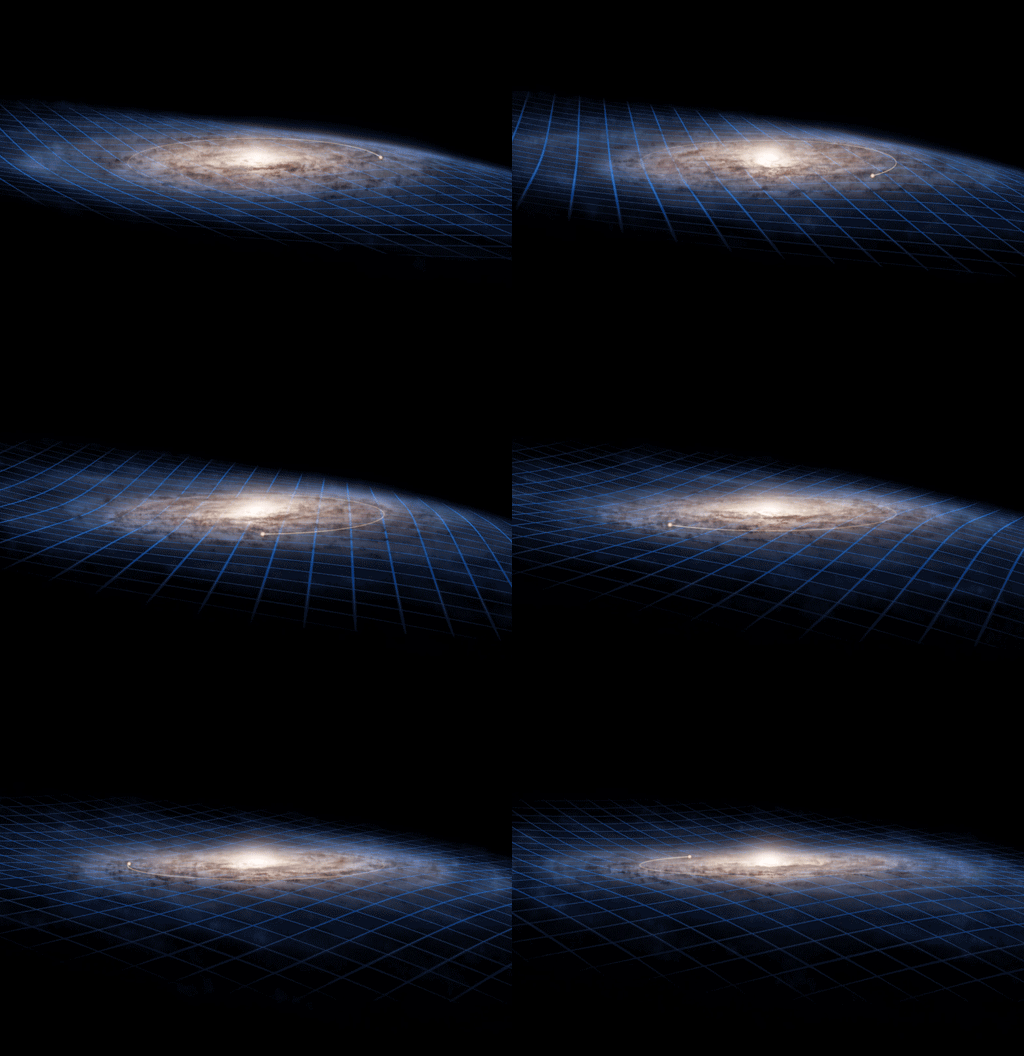
The Universe begins with negligible amounts of angular momentum, which is always conserved. So why do planets, stars, and galaxies all spin?

From the tiniest subatomic scales to the grandest cosmic ones, solving any of these puzzles could unlock our understanding of the Universe.

It's the very closest stars to us that hold the key to unlocking the possibilities for life in star systems all throughout the Universe.

In the 20th century, many options abounded as to our cosmic origins. Today, only the Big Bang survives, thanks to this critical evidence.

The Big Bang is commonly misunderstood, warping our understanding about the Universe's size and shape.

The theory is accurate within at least one part in a quadrillion.