




















Search
Universe Expansion

You would think that with all our technology, like the James Webb Space Telescope, we would know how big the Universe is. But we don't.

Black holes aren't just the densest masses in the Universe, but they also spin the fastest of all massive objects. Here's why it must be so.

In our common experience, you can't get something for nothing. In the quantum realm, something really can emerge from nothing.
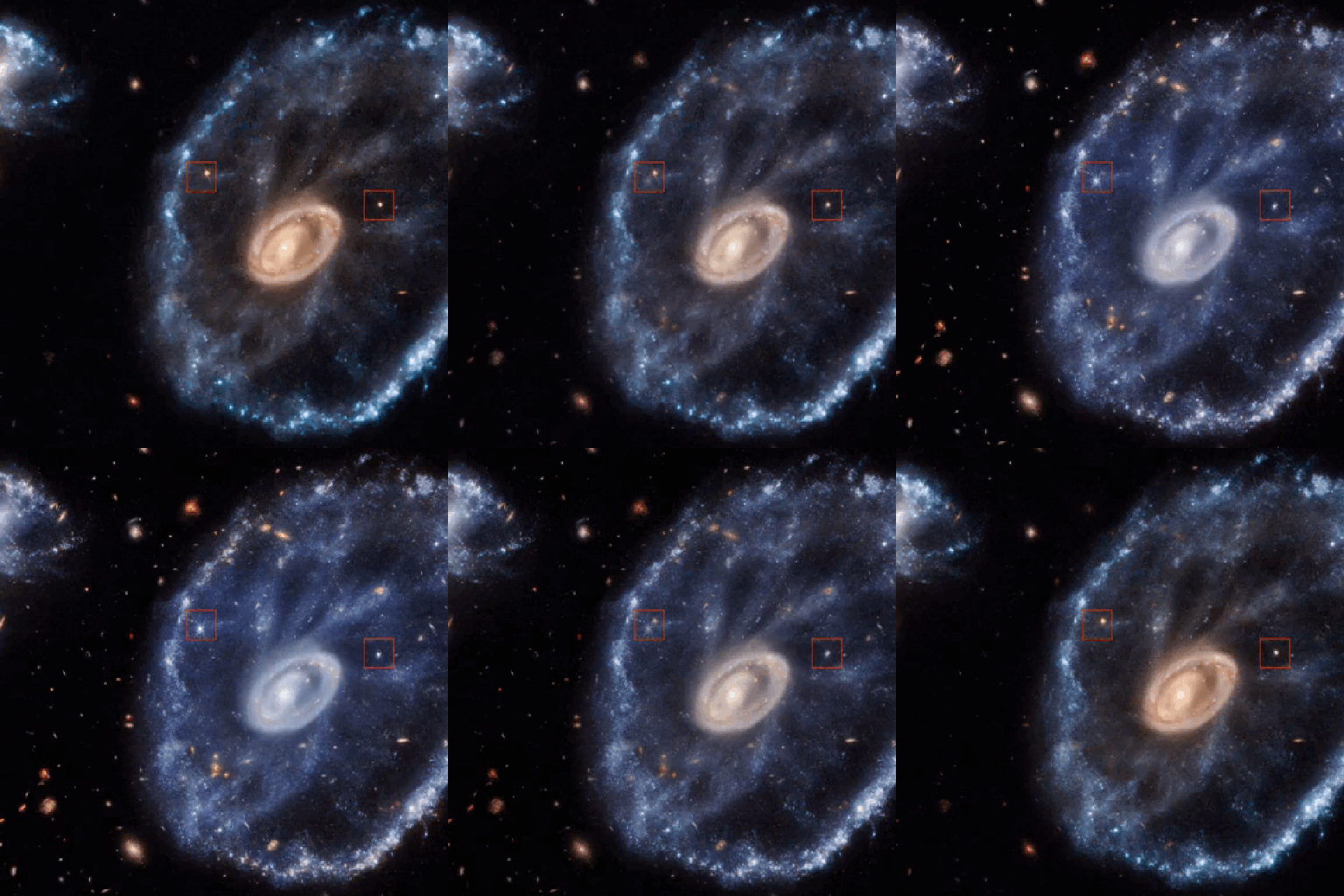
The first set of James Webb's images blew us all away. In just 2 mere months, it's seen highlights that no one could have predicted.

As recently as 1990, we didn't know of any planets beyond our Solar System. Today, with 5000+, we're deep into the weeds of how they form.


No planet enters retrograde more frequently than Mercury, which does so 3-4 times each year. Here’s the scientific explanation for why.

Einstein's relativity teaches us that time isn't absolute, but passes relatively for everyone. So how do telescopes see back through time?

The last 70 years have taken us farther than the previous 70,000. But can we accomplish more than creating a record saying, "We were here?"

From black holes to dark energy to chances for life in the Universe, our cosmic journey to understand it all is just getting started.

No. No no no. Just... no. The JWST has truly blown our scientific minds, but it's a pure crackpot idea that the Big Bang is now disproven.

Unexpected images of galaxies from the James Webb Space Telescope do not disprove the Big Bang. There are other likelier explanations.

Hubble revolutionized astronomy more than once. Here's what we can expect from the James Webb Space Telescope.

Einstein's "happiest thought" led to General Relativity's formulation. Would a different profound insight have led us forever astray?

Our model of the Universe, dominated by dark matter and dark energy, explains almost everything we see. Almost. Here's what remains.

Magnetic monopoles began as a mere theoretical curiosity. They might hold the key to understanding so much more.

The anthropic principle has fascinating scientific uses, where the simple fact of our existence holds deep physical lessons. Don't abuse it!

At their cores, stars can reach many millions or even billions of degrees. But even that doesn't touch the hottest of all.

The key problem with the dark matter hypothesis is that nobody knows what form dark matter might take.

There's an extra source of massive "stuff" in our Universe beyond what gravitation and normal matter can explain. Could light be the answer?

If you have an old TV set with the "rabbit ear" antennae, and you set it to channel 03, that snowy static can reveal the Big Bang itself.

Unless you have a critical mass of heavy elements when your star first forms, planets, including rocky ones, are practically impossible.
In all the Universe, only a few particles are eternally stable. The photon, the quantum of light, has an infinite lifetime. Or does it?

With a telescope at just the right distance from the Sun, we could use its gravity to enhance and magnify a potentially inhabited planet.

We only detected our very first gravitational wave in 2015. Over the next two decades, we'll have thousands more.

We knew we'd find galaxies unlike any seen before in its first deep-field image. But the other images hold secrets even more profound.

Ever since the start of the hot Big Bang, time ticks forward as the Universe expands. But could time ever run backward, instead?

Searching for dark matter, the XENON collaboration found absolutely nothing out of the ordinary. Here's why that's an extraordinary feat.

"The surface is no longer a record of every impact the moon has ever had, because at some point, impacts were erasing previous impacts."

Even though the leftover glow from the Big Bang creates a bath of radiation at only 2.725 K, some places in the Universe get even colder.