




















Search
Universe Expansion

There's a speed limit to the Universe: the speed of light in a vacuum. Want to beat the speed of light? Try going through a medium!

Take a peek at the pre-release images used to calibrate and commission JWST's coldest instrument, now ready for full science operations.

Scientists have found three new examples of a very exotic form of matter made of quarks. They can yield insights into the early Universe.

It started with a bang, but won't end with one. Instead, it will "rage against the dying of the light" like nothing you've ever imagined.

Like humans, stars die. The James Webb Space Telescope's early images already give us a lot of information about how this happens.

Even with only 12.5 hours of exposure time, James Webb's first deep-field image taught us lessons we've never realized before.

Astronomy's roots rest in the very origins of humanity. We have always looked to the skies for answers. We are starting to get them.

Now that it's fully commissioned, the James Webb Space Telescope begins its exploration of the Universe. Here are its first science images!

With its very first deep-field view of the Universe now released, the James Webb Space Telescope has shown us our cosmos as never before.
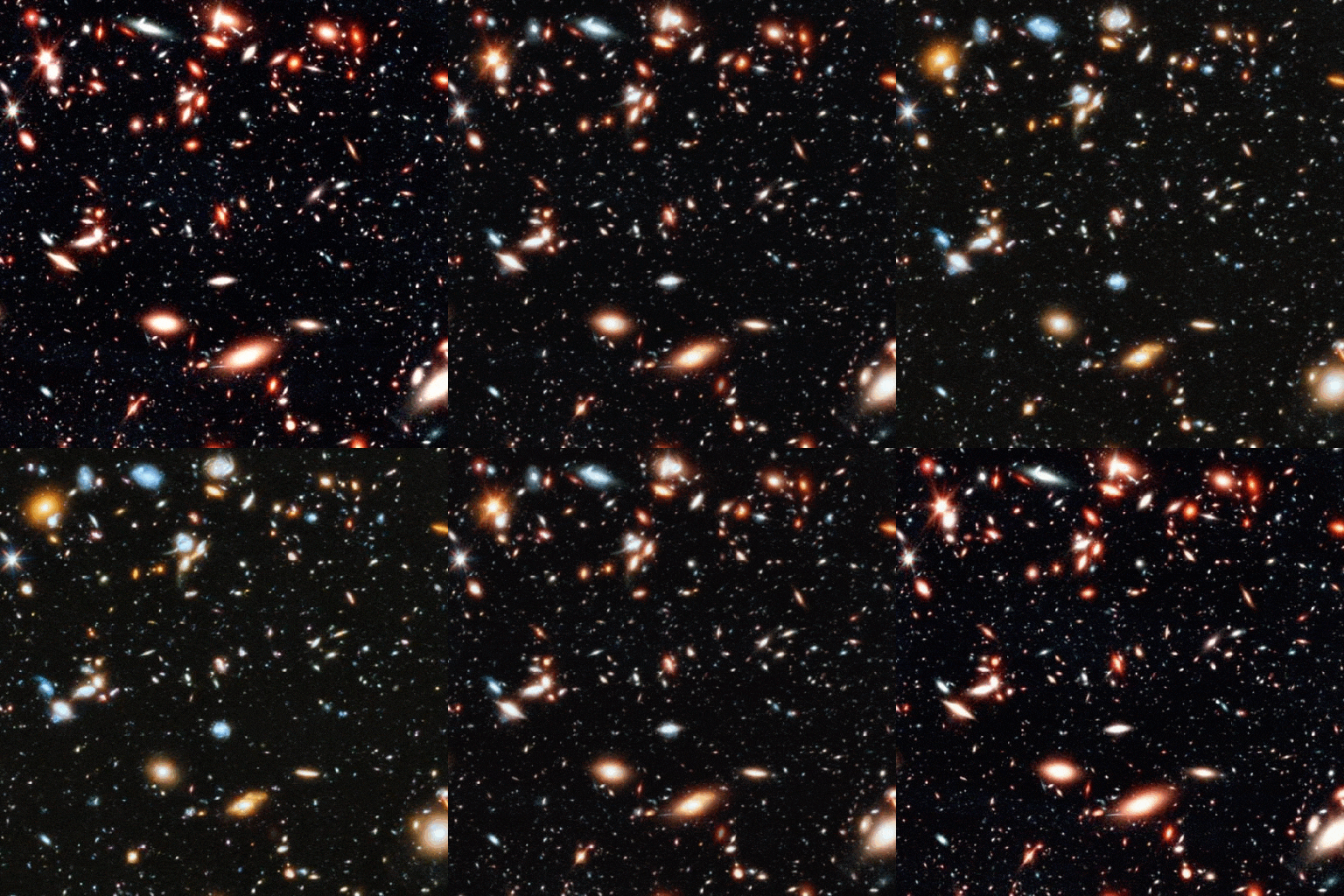
The James Webb Space Telescope has chosen 5 targets for its first science release. Here's what we know on the eve of JWST's big reveal!

The neutrino is the most ghostly, rarely-interacting particle in all the Standard Model. How well can we truly make "beams" out of them?

LIGO can detect the inspirals and mergers of the lowest-mass black holes, but not the biggest ones. Here's how pulsars can help.

At all distances, the Universe expands along our line-of-sight. But we can't measure side-to-side motions; could it be rotating as well?

Modern cosmology conjectures different possible fates for the Universe and thus for the end of time. Details depend on which model is right.


On July 4, we celebrate the tenth anniversary of the discovery of the Higgs boson, the missing piece of the Standard Model of particle physics.

No matter how beautiful, elegant, or compelling your idea is, if it disagrees with observation and experiment, it's wrong.

The Universe is expanding, and the Hubble constant tells us how fast. But how can it be a constant if the expansion is accelerating?

The discovery calls into question the few things scientists know about these powerful astronomical phenomena.
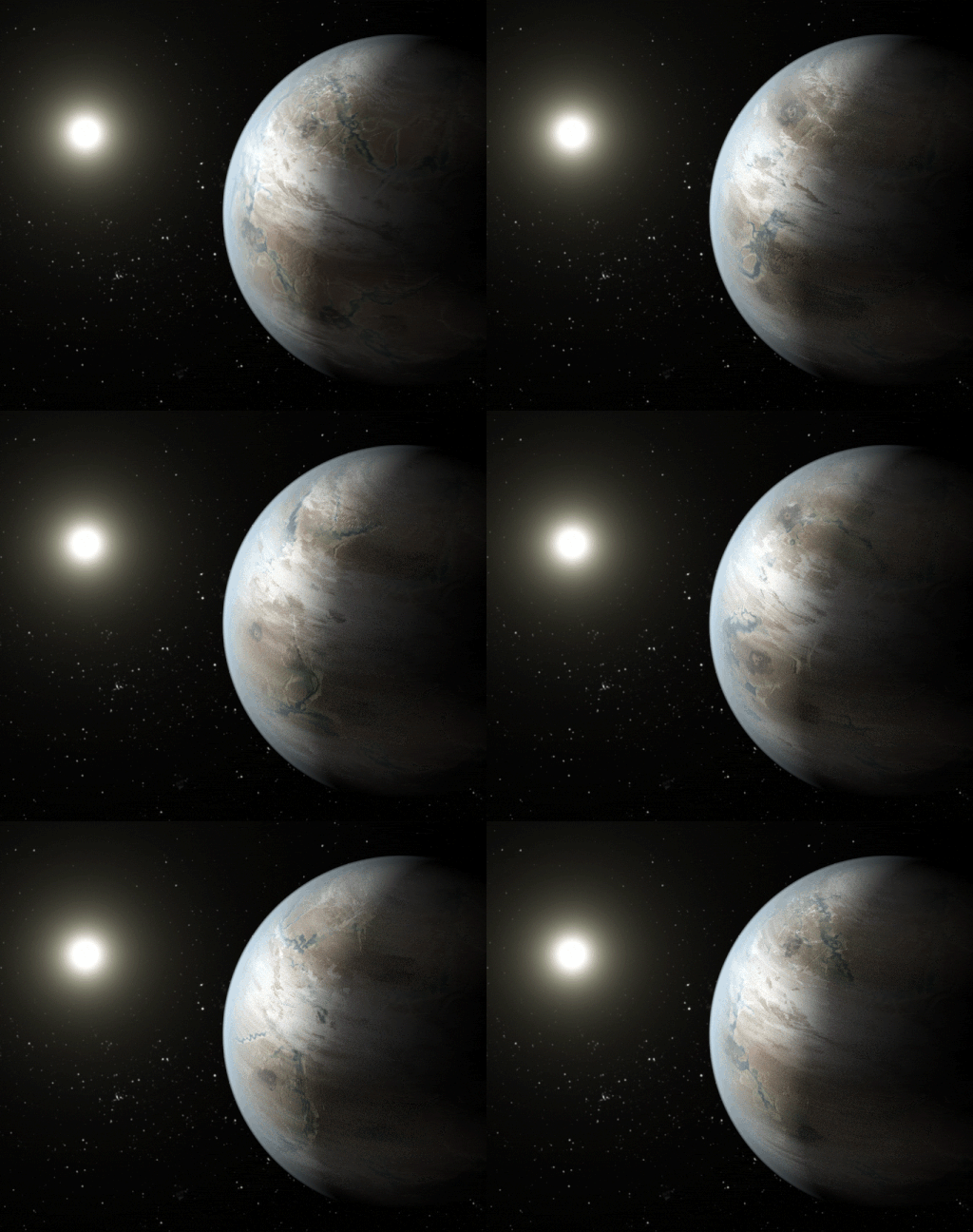
There are billions of potentially inhabited planets in the Milky Way alone. Here's how NASA will at last discover and measure them.

When stars form, they emit energetic radiation that boils gas away. But it can't stop gravitational collapse from making even newer stars.

If you think you know how an astronomical nova works, buckle up. You're in for a ride like you never expected.

Earth is the Solar System's only known inhabited planet. Could Venus, if its phosphine signal is real, be our second world with life?

On July 12, 2022, NASA will release the first science images taken with the James Webb Space Telescope. Here's what to hope for.

The James Webb Space Telescope is about to begin science operations. Here's what astronomers are excited about.

Where did the “seed” magnetic field come from in the first place?


We've only seen Uranus up close once: from Voyager 2, back in 1986. The next time we do it, its features will look entirely different.

The Standard Model of elementary particles has three nearly identical copies of particles: generations. And nobody knows why.

On July 12, 2022, JWST will release its first science images. Here are 5 ways the telescope's findings could change science forever.