




















Search
Universe Expansion

There is nothing more important to science than its ability to prove ideas wrong.

Humans who've lived through the same events often remember them differently. Could quantum physics be responsible?

According to renowned physicist Christophe Galfard, physics can’t explain our universe - yet.
John Templeton Foundation

The observable Universe is 92 billion light-years in diameter. These pictures put just how large that is in perspective.

Some astrobiologists believe life is rare, while others believe it is common in the Universe. How can we find out which view is correct?

Over time, the Universe becomes less dominated by dark matter and more dominated by dark energy. Is one transforming into the other?


"The pulsar sort of consumes the thing that recycled it, just as the spider eats its mate.”

13.8 billion years ago, the hot Big Bang gave rise to the Universe we know. Here's why the reverse, a Big Crunch, isn't how it will end.

Everything is made of matter, not antimatter, including black holes. If antimatter black holes existed, what would they do?

Do the laws of physics place a hard limit on how far technology can advance, or can we re-write those laws?

At four million solar masses, the Milky Way's supermassive black hole is quite small for a galaxy its size. Did we lose the original?

Time isn't the same for everyone, even on Earth. Flying around the world gave Einstein the ultimate test. No one is immune from relativity.

Astronomers in 2017 caught an image of a supermassive black hole in a galaxy far, far away. Doing it in our own galaxy is a huge milestone.

After years of analysis, the Event Horizon Telescope team has finally revealed what the Milky Way's central black hole looks like.

In Sun-like stars, hydrogen gets fused into helium. In the Big Bang, hydrogen fusion also makes helium. But they aren't close to the same.

The Standard Model may or may not be in trouble, but particle physics definitely needs saving. Here's what the new LHC can do.

5mins
Why are we here? What is everything made of? This theoretical physicist says science isn’t the right way to answer these questions.
John Templeton Foundation

Everything that gets heated up has to, somehow, radiate that energy away. Here's what we see when that happens in the Universe.

For a thousand light-years in all directions, there's a "bubble" that the Sun sits at the center of. Here's the story behind it.

Extremely precise atomic clocks are not just of theoretical interest; they could help detect impending volcanic eruptions or melting glaciers.

All life forms, anywhere in our Universe, are chemically connected yet completely unique.

Look out at a distant object, and you're not seeing it as it is today. It's size, brightness, and actual distance are all different.
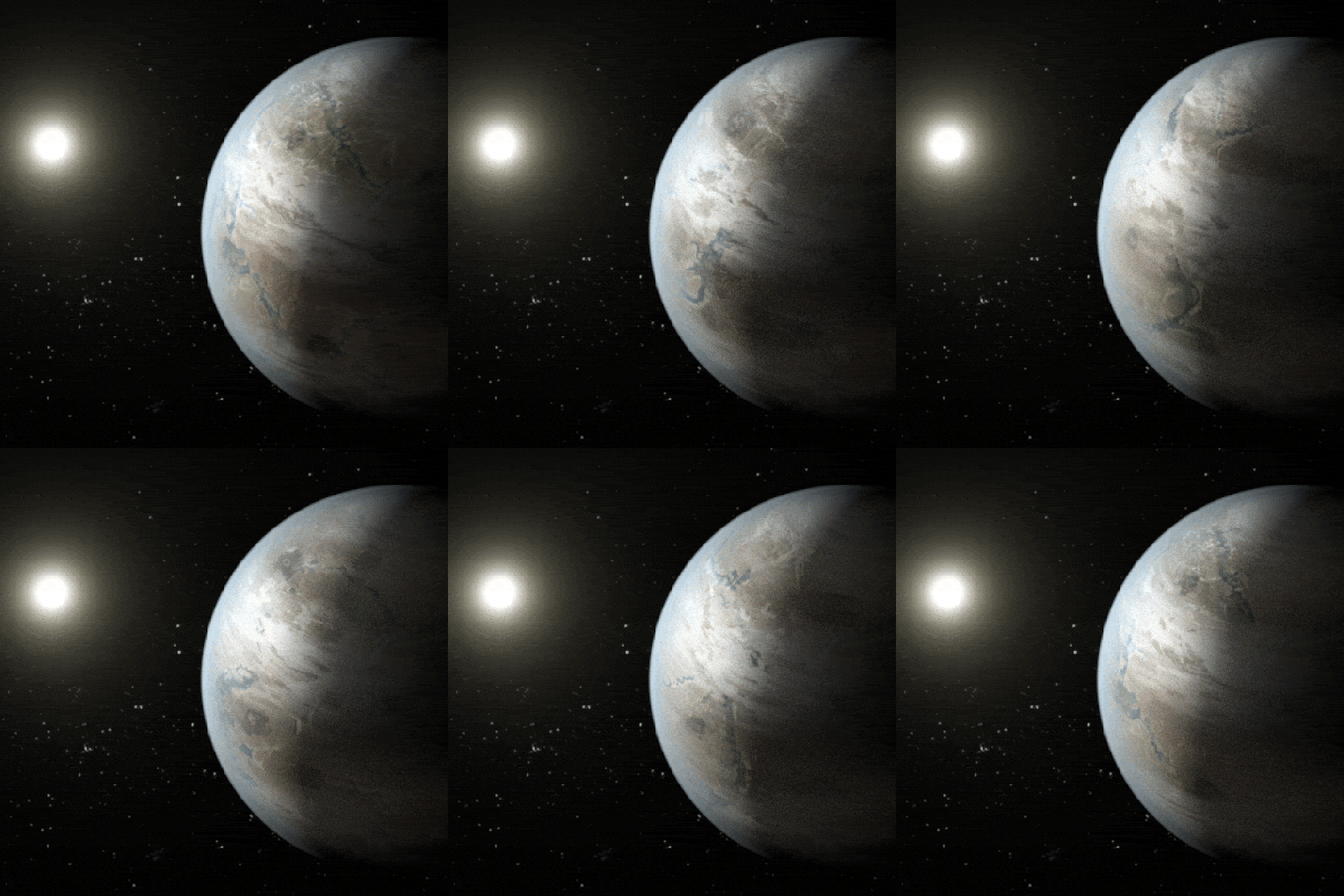
If there are human-sized creatures walking around on other planets, would we be able to view them directly?

Singularities frustrate our understanding. But behind every singularity in physics hides a secret door to a new understanding of the world.

Ancient helium-3 from the dawn of time leaks from the Earth, offering clues to our planet’s formation. A key question is where it leaks from.

Dr. Tyson explains where we might find aliens, why "dark matter" is a misleading term, and why you can blame physics for your favorite team's loss.

Single objects rarely change the course of an entire scientific field. Distant object GNz7q, a galaxy-quasar hybrid, might do exactly that.

For some reason, the charges on the electron and proton are equal and opposite, and their numbers are equal, too. But why?

As far as we can tell, there's no limit to how far it goes on; only a limit to how far we can see. Could the Universe truly be infinite?