




















Search
Astronomy

Many facts are well-known to professionals, but are unappreciated or even rejected outright by the public. "How stars work" takes the cake.

Our dream of journeying to other star systems has a big obstacle to overcome: the vast interstellar distances. Can antimatter get us there?

Although a star's "birth" is well-defined, it doesn't correspond to an ignition event in its core. Here's how stars are actually born.

From 2004 through 2017, Saturn was imaged many times and from many angles up close by Cassini. This new viral image isn't real; it's AI.

One parameter, alone, sets the dividing line between rocky planets, gas giants, brown dwarfs, stars, and much more. Here's why mass matters.

The distance ladder and the CMB give incompatible values for the expansion rate. A new study shows just how robust the Hubble tension is.

By looking at a giant, remarkable, edge-on protoplanetary system, astronomers have found a proto-protoplanet for the first time.

Human beings have now traveled farther from Earth than ever before with Artemis II's flyby of the lunar far side. Here's how it happened.

As the world teeters on the brink of nuclear war, distant, advanced civilizations would never know it. Earth appears peaceful from far away.

The 1st generation of stars formed, lived, and died very early on. But 2nd generation stars could still persist today. Did we just find one?

As humanity journeys to the Moon for the first time since 1972, can we rediscover our shared responsibilities: to the world and each other?
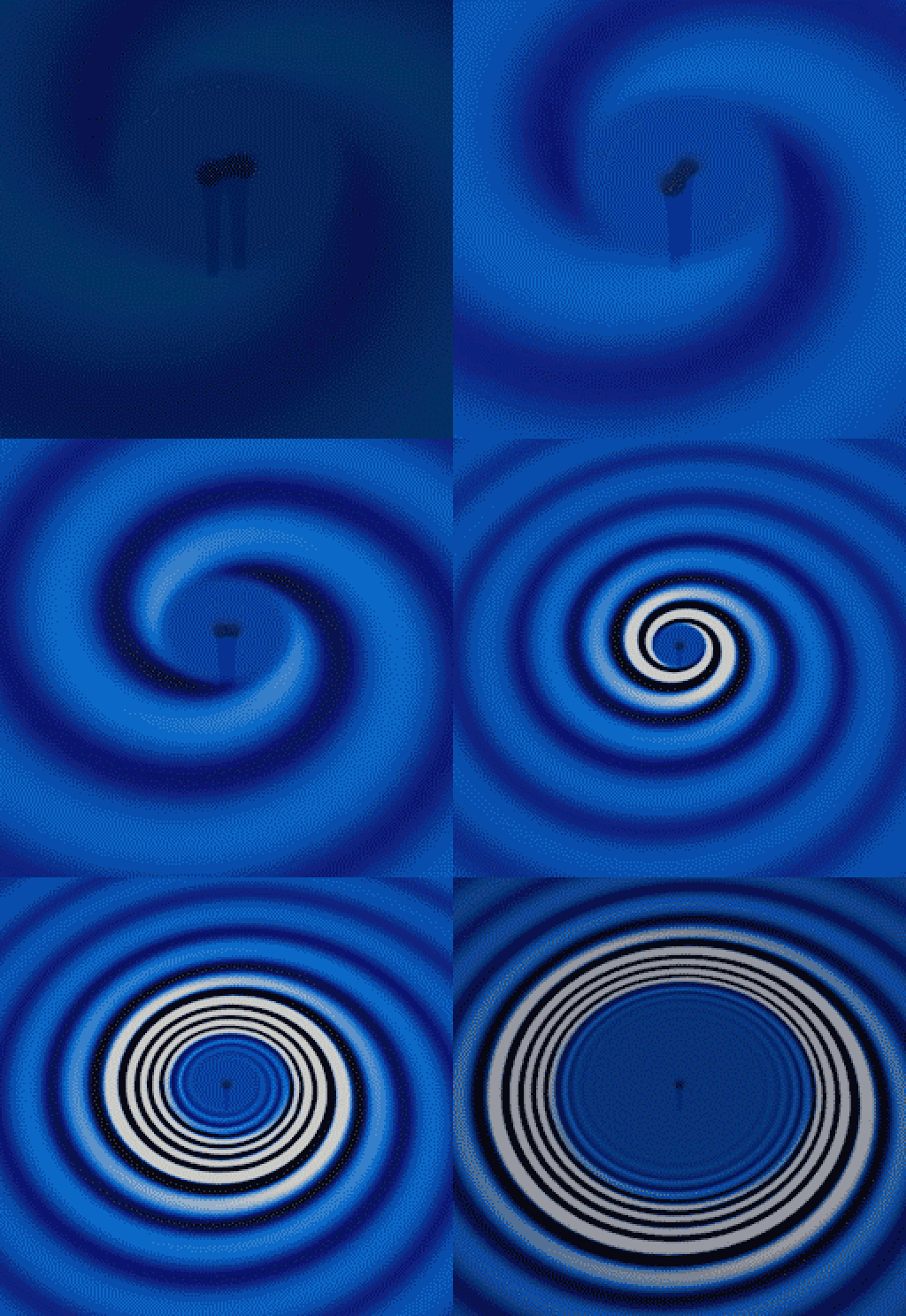
As light travels across the Universe, it's subject to cosmic expansion, changing fields, and relative motion. How about gravitational waves?

Even though no human has stepped foot on the Moon's surface in 50 years, the evidence of our presence there remains unambiguous.

Most massive galaxies are spiral or elliptical shaped. But peculiar galaxies showcase the beautiful violence that helps explain our cosmos.

Early on, the Universe needed near-perfect flatness, or atoms, stars, and galaxies couldn't form. What happens once dark energy takes over?
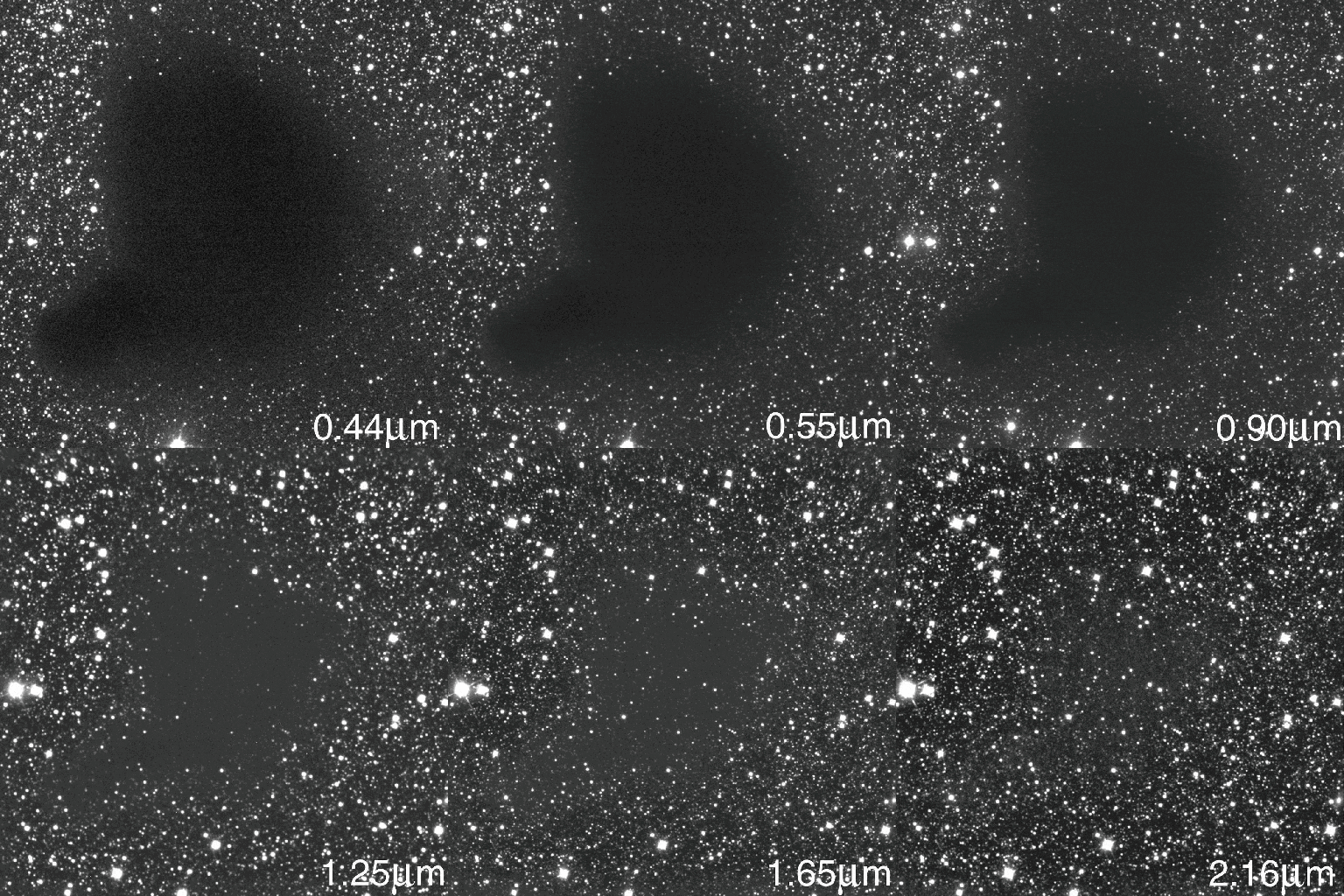
The image you're seeing isn't a hole in the Universe, and the cosmic voids that do exist aren't hole-like at all.

Looking up at the night sky gives us a glimpse of the Universe beyond our terrestrial concerns. Here's the science of what's out there.

In theory, the fabric of space could have been curved in any way imaginable. So why is the Universe flat when we measure it?

Binary black holes eventually inspiral and merge. That's why the OJ 287 system is destined for the most energetic event in history.

Over billions of years, fewer stars form, galaxies mutually recede, and the Universe becomes ever darker. Here's how fast it all happens.

The path to exploring the high-energy Universe was clear and compelling. Here's how 2025's cuts are still causing NASA casualties in 2026.

Not everyone accepts the scientific consensus; some even make careers out of challenging it. But only a select few do it the right way.

Resembling a cosmic brain, the Exposed Cranium Nebula instead shows a dying, massive star, as JWST reveals. Its fate remains uncertain.

In traveling through the expanding Universe, particles slow down while light and gravitational waves redshift. What degrades and what won't?

No civilization, no matter how successful, can last forever. What does the non-detection of intelligent aliens mean for our own longevity?

The discovery of CDG-2, a galaxy that's more than 99.9% dark matter, could reveal a new population of ultra-faint galaxies. But is it real?

No human has ever left the Solar System, and only six already-launched spacecraft will ever exit it. Will Voyager 1 remain the most distant?

Quantum entanglement links information between particles across space and time. So what happens when one of them falls into a black hole?

Forget about the terawatt lasers we're making on Earth. The Universe makes natural ones thousands of times more powerful than the Sun.

Even space and time are relative in Einstein's universe. That means our old notions of "where" and "when" no longer apply on cosmic scales.