
















History and Society

History and Society

a painting of a group of men standing next to each other.
From landscaped gardens to road systems, the Persians were among the first to create many things we still enjoy today.
A fork holds a piece of lettuce, partially obscured by a bright yellow glow against a dark background.
A growing movement is trying to turn energy directly into food — reviving an old dream of escaping the violence and inefficiency of eating.
Illustration of Earth overlaid with a grid and energy types from the Kardashev Scale: Type I, II, and III, representing planetary, stellar, and galactic energy usage.
The famous framework ranks civilizations by energy use — but ignores a critical factor that can halt their progress.
World map showing global oil reserves, rare earth elements deposits (yellow dots), and major shipping routes and chokepoints, with oil reserves highlighted by pink circles of varying sizes.
As the global economy moves beyond oil, the strategic importance of the world’s most critical hydrocarbon chokepoint is likely to decline rapidly.
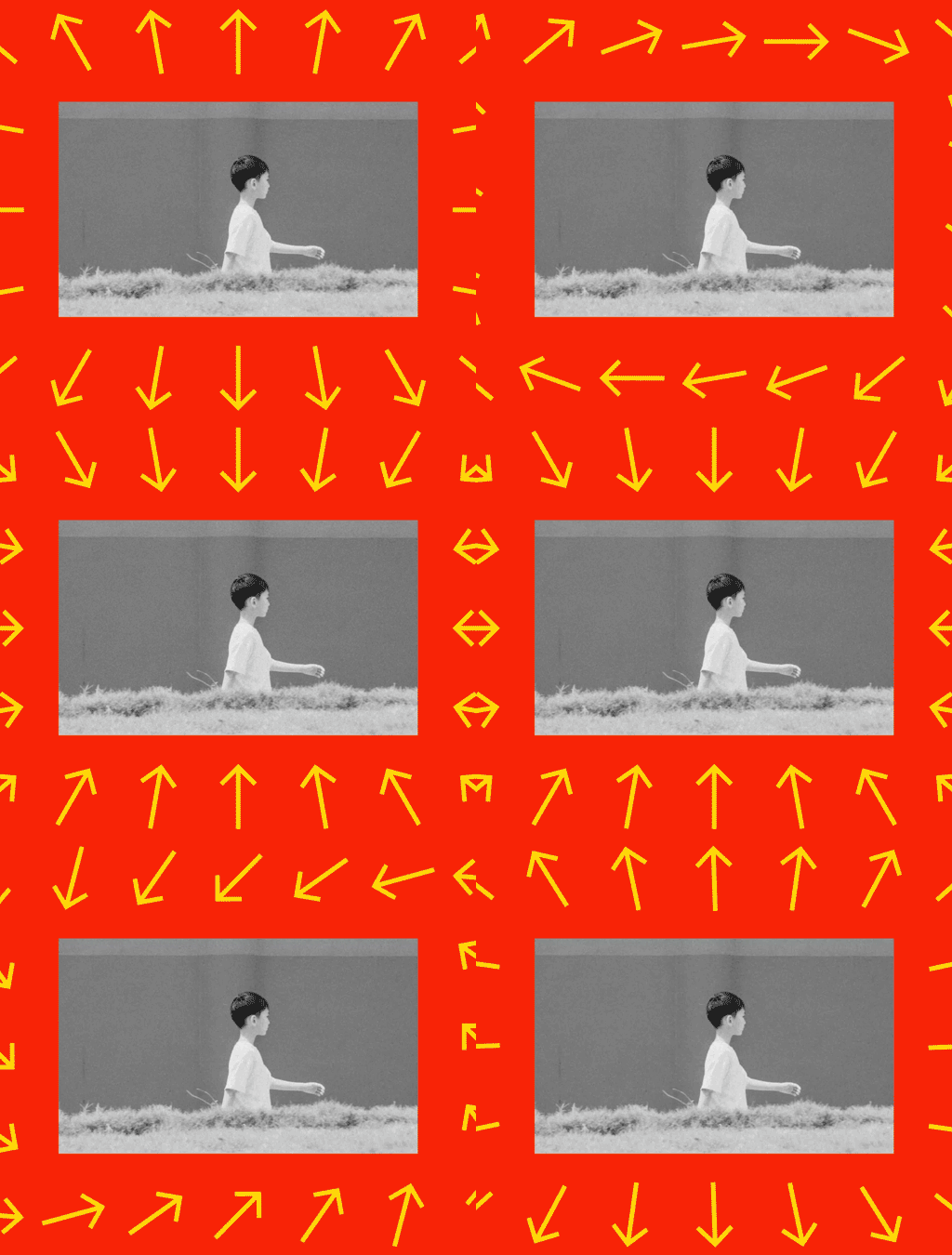
A black-and-white photo of a person walking in profile, centered on a red background with multiple yellow arrows pointing outward in all directions—a striking design inspired by modern China.
A firsthand look at China’s material progress and clean-tech revolution -- and what could happen if we let an authoritarian state steer AI's future.
Split image: left side shows a pencil sketch of a person's lower face, while the right reveals a painted portrait's lower face and neck with a red beaded necklace and ruffled collar—capturing hints of why we talk funny.
Long before today's debates, immigration was already transforming the American accent into something distinctively its own.
Black-and-white photo of Jan Morris, an older person seated on a bed, smiling with a typewriter in front. The book cover text reads: "Jan Morris, a life, Sara Wheeler.
Jan Morris's biographer confronts the limits of storytelling while trying to capture a life defined by contradiction and reinvention.
Earth rises above the horizon of the Moon, with the lunar surface in the foreground and space in the background.
Globalization did not fail — it improved the lives of billions of people. The next phase of human development could push us to a new level of global abundance.
The cover of the book "The Future of Free Speech" by Jacob Mchangama and Jeff Kosseff, with part of the cover image pixelated, explores topics like Germany free speech in a rapidly changing world.
Germany built aggressive systems to combat hate speech, but the line between defending democracy and undermining it may be beginning to blur.
Four people wearing black shirts and eclipse glasses look up at the camera indoors, their excitement echoing the spirit of the Artemis II distance record mission.
Human beings have now traveled farther from Earth than ever before with Artemis II's flyby of the lunar far side. Here's how it happened.
A map of the United States showing the most popular paint color in each state, with names of various gray, blue, and neutral shades labeled over the corresponding states.
The ideology, economics, and psychology behind the modern world's draining of color from homes, cars, and everyday objects.
The word "intelligence" in gray lowercase letters on a black background, with a subtle spotlight effect highlighting the center of the text, inspired by Frames of Mind.
Howard Gardner joins us to reflect on the theory of multiple intelligences and why the question of who owns intelligence is more important than ever.
moon landing Apollo 11
Even though no human has stepped foot on the Moon's surface in 50 years, the evidence of our presence there remains unambiguous.
Historic map illustration of the city of Tenochtitlan, surrounded by water, with labeled features and detailed buildings, from the early colonial period in Mexico.
This 1524 map of the Aztec capital was a window into an exotic otherworld — and largely a fiction.
A colorful map shows the distribution of nearby galaxies, with distances and redshift factors labeled, created by DESI; NSF, NOIRLab, and Kitt Peak logos are visible.
Is dark energy evolving with at least 99.99% confidence? Despite the quality of recent data, scientists have every reason to be skeptical.
A group of people stands and plays cricket in an urban park at dusk, with city buildings, trees, and illuminated streetlights in the background.
The ozone hole was going to destroy life as we know it, but an unprecedented global effort fixed the problem.
A sliced onion bulb with roots and stem, illuminated from behind and set against a black background, resembles the delicate layers of daffodils in bloom.
What a fragile flower can teach us about resilience, death, and becoming someone new.
A shirtless man, resembling Tommy Caldwell, climbs a steep rock face high above the ground, reaching for a hold with one hand and gripping the rock with the other; trees and a valley stretch out below.
A day in the Sierra Nevada with Tommy Caldwell reveals how pain, trauma, and “elective hardship” became the foundation of his fortitude.
A young child sits on a sidewalk holding a scraped knee next to a fallen scooter, evoking reasonable childhood independence, with collage elements including a helicopter, art print, and abstract lines.
When can a kid play outside alone? Two parents, one stranger, and the state collide.
A collage of overlapping browser windows displays various images—symbols, people, gold bars, and abstract patterns—all connected by dashed red lines, evoking the tangled web of conspiracy theories.
Long-debunked conspiracies don’t disappear—they evolve and thrive in the age of algorithms.
Book cover of "True Color" by Kory Stamper, featuring illustrations of twelve colored book spines—echoing the era of the dye famine—arranged in a grid on a beige background.
When America lost access to German dyes, the crisis revealed a startling truth: color was chemical, tactical, and essential to warfare.
logarithmic history of universe
In a 13.8 billion year old Universe, a few seconds hardly seems like it matters. But these minuscule changes sure do add up over time.
Two peculiar galaxies collide in deep space, forming bright clusters and swirling dust clouds—a striking scene that reveals the beauty and violence of the cosmos against a dark background.
Most massive galaxies are spiral or elliptical shaped. But peculiar galaxies showcase the beautiful violence that helps explain our cosmos.
Historic map illustration of a star-shaped fortified city with surrounding moat, labeled roads, and buildings visible outside the city walls.
First rising in the 15th century, these forts sought to counter a deadly innovation in military technology.
The book cover of "Love Thy Stranger" by Bart D. Ehrman features a painting of four biblical figures and the subtitle, inspired by the command to "love thy stranger," exploring how Jesus’ teachings transformed Western moral conscience.
Biblical scholar Bart Ehrman contends that our modern sense of altruism can be traced back to the radical shift in ethical thinking sparked by Jesus' teachings.
Older man with gray hair wearing a dark suit, patterned tie, and blue shirt, gesturing with both hands, seated against a plain white background.
21mins
Archaeologist Eric Cline has spent his career forensically reconstructing why the Bronze Age collapsed, and the answer is far stranger and more unsettling than a single catastrophic event.
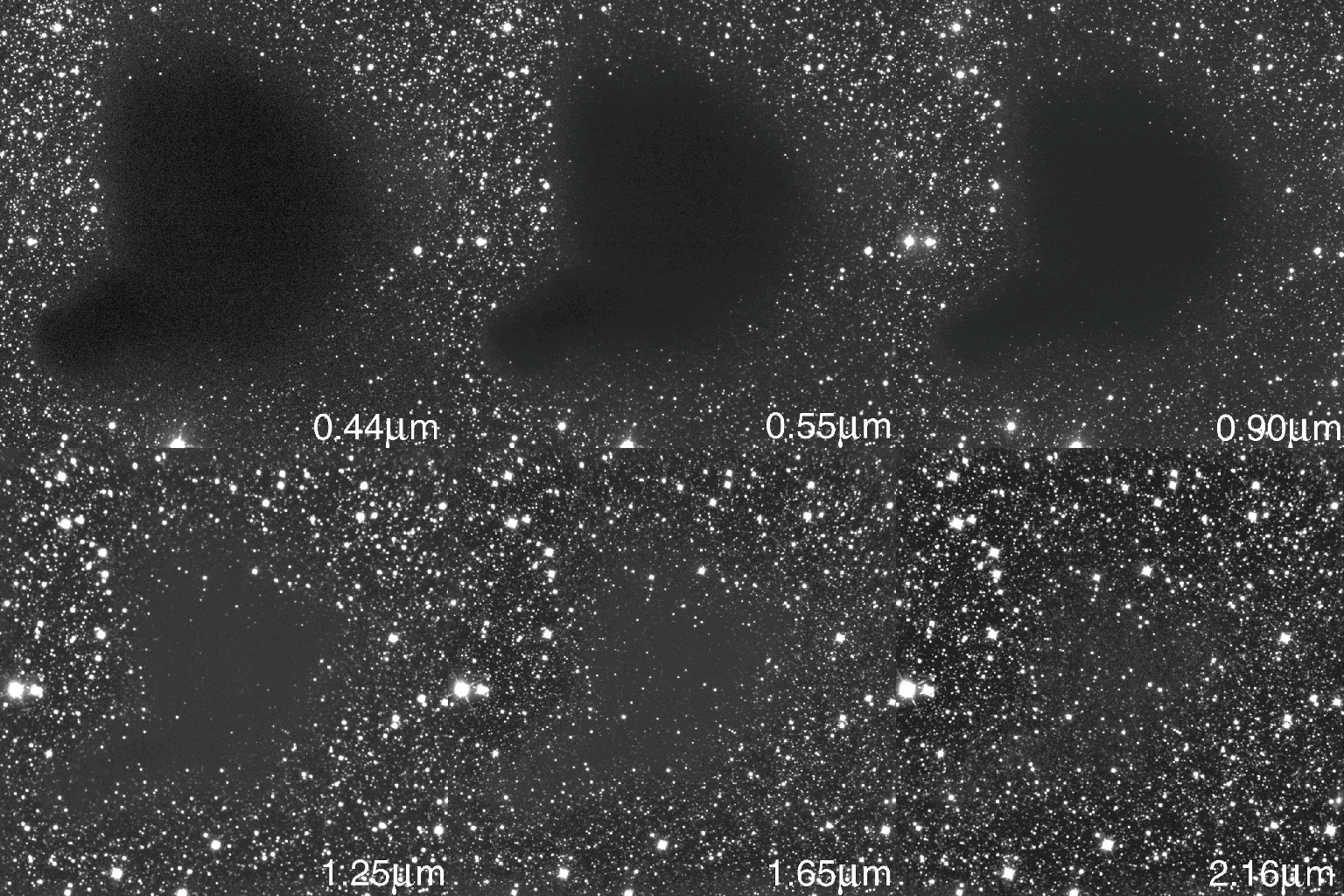
bok globule barnard 68 dust wavelength
The image you're seeing isn't a hole in the Universe, and the cosmic voids that do exist aren't hole-like at all.
An older man with gray hair wearing a dark suit, blue shirt, and patterned tie, sitting against a plain light background.
22mins
Historian Eric Cline illuminates the 400-year period following ancient collapse that shaped the modern world.
A person sits on a chair against a white backdrop with abstract black dotted patterns, set against a yellow background.
1hr 16mins
NASA astronomer Michelle Thaller makes the case that quantum entanglement may be the underlying fabric from which spacetime itself emerges.