




















Search
Science and Tech

Many facts are well-known to professionals, but are unappreciated or even rejected outright by the public. "How stars work" takes the cake.

Our dream of journeying to other star systems has a big obstacle to overcome: the vast interstellar distances. Can antimatter get us there?

A new generation of self-healing tools could make the U.S.'s aging power grid far more resilient against modern threats.

Data centers consume enormous amounts of power, but their steady demand could make the grid more efficient — and lower costs for everyone.

A growing movement is trying to turn energy directly into food — reviving an old dream of escaping the violence and inefficiency of eating.

A Columbia researcher argues that everything from stress to aging comes down to how energy moves through your body.

The famous framework ranks civilizations by energy use — but ignores a critical factor that can halt their progress.

As the global economy moves beyond oil, the strategic importance of the world’s most critical hydrocarbon chokepoint is likely to decline rapidly.

A firsthand look at China’s material progress and clean-tech revolution -- and what could happen if we let an authoritarian state steer AI's future.

On cosmic scales, only dark matter (or something equivalent) gives us the Universe we observe. Now, the Sunyaev-Zel'dovich effect agrees.

Although a star's "birth" is well-defined, it doesn't correspond to an ignition event in its core. Here's how stars are actually born.

Every time a new star forms, there's an opportunity to form planets alongside and around it. How does it happen, and how long does it take?

"Color" with respect to the strong force is just an analogy. Here's how to understand it without colors, group theory, or any advanced math.

From 2004 through 2017, Saturn was imaged many times and from many angles up close by Cassini. This new viral image isn't real; it's AI.

One parameter, alone, sets the dividing line between rocky planets, gas giants, brown dwarfs, stars, and much more. Here's why mass matters.

The distance ladder and the CMB give incompatible values for the expansion rate. A new study shows just how robust the Hubble tension is.

By looking at a giant, remarkable, edge-on protoplanetary system, astronomers have found a proto-protoplanet for the first time.

Human beings have now traveled farther from Earth than ever before with Artemis II's flyby of the lunar far side. Here's how it happened.

Mars was warmer and wetter long ago. If anything was alive there, what came next was either a tragedy or a masterclass in survival.

Known as the "past hypothesis" problem, the Universe's initially low entropy has long puzzled scientists. Now, cosmic inflation solves it.

As the world teeters on the brink of nuclear war, distant, advanced civilizations would never know it. Earth appears peaceful from far away.

As AI overwhelms the web, we will need a way to distinguish people from machines.

The 1st generation of stars formed, lived, and died very early on. But 2nd generation stars could still persist today. Did we just find one?

As humanity journeys to the Moon for the first time since 1972, can we rediscover our shared responsibilities: to the world and each other?
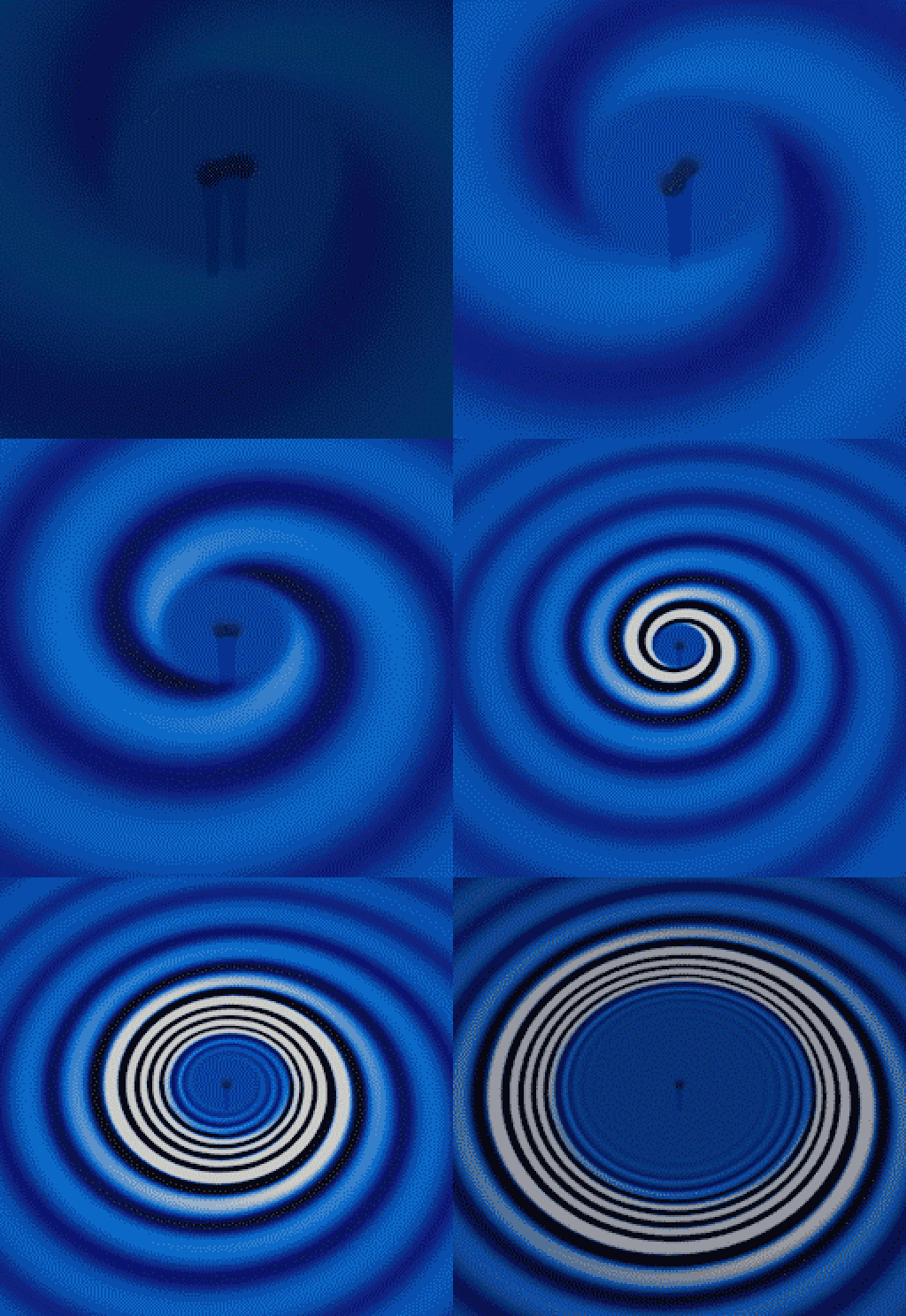
As light travels across the Universe, it's subject to cosmic expansion, changing fields, and relative motion. How about gravitational waves?

This 1524 map of the Aztec capital was a window into an exotic otherworld — and largely a fiction.

The ozone hole was going to destroy life as we know it, but an unprecedented global effort fixed the problem.

Cognitive flexibility, opportunistic survival, and social cooperation have allowed rats to thrive in conditions that wipe out other species.

Instead of hauling heavy building materials across space, future astronauts may grow fungal shelters from spores, waste, and local regolith.

A broken laptop hinge revealed a broader shift in how modern products are designed, sold, and owned